How-To Guides
Authentication
Every request (except /healthz) requires a valid ICICLE AI tenant Tapis access token in the X-Tapis-Token header. The service:
- Verifies the JWT signature via JWKS
- Checks the token is not expired
- Validates the issuer matches
TAPIS_ISSUER - Ensures
tapis/tenant_idisicicleai - Extracts
tapis/usernamefor per-user data isolation
How to get your access token
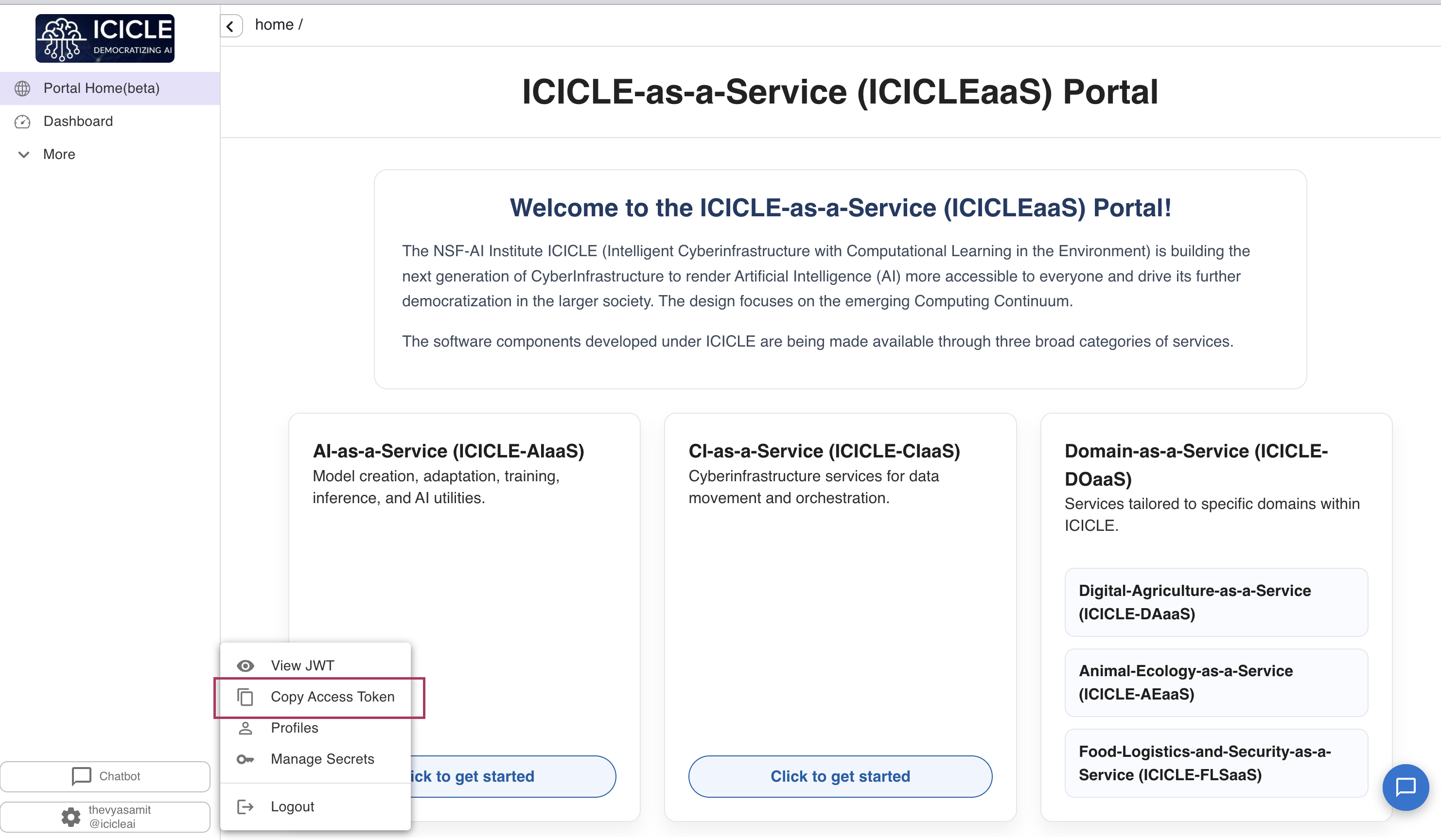
Log in to the ICICLE AI Tapis UI, click your username in the bottom-left corner, and select Copy Access Token.
| Scenario | Status | Response |
|---|---|---|
No X-Tapis-Token header | 422 | "field required" |
| Expired token | 401 | "The access token has expired." |
| Wrong issuer | 401 | "Invalid token issuer. Expected: ..." |
Wrong tenant (e.g. tacc) | 403 | "Access denied. This service accepts tokens from the 'icicleai' tenant only." |
| Invalid/malformed token | 401 | "The access token could not be validated." |
How to Store an Embedding
collection (required) is the broad domain. topic (optional) is a sub-category within it.
curl -X POST http://localhost:8000/v1/embeddings \
  -H "X-Tapis-Token: $TAPIS_TOKEN" \
  -H "Content-Type: application/json" \
  -d '{
    "embedding": [0.12, -0.34, ...],
    "collection": "biology",
    "topic": "plant",
    "chunks": ["Photosynthesis is the process by which green plants..."],
    "metadata": {"source": "biology_notes.pdf", "page": 1},
    "embedding_model": "gemini-embedding-001"
  }'
Response (201):
{
  "id": "abc-123-def",
  "user_id": "thevyasamit",
  "collection": "biology",
  "topic": "plant",
  "created_at": "2026-04-03T10:30:00+00:00",
  "updated_at": "2026-04-03T10:30:00+00:00",
  "embedding_model": "gemini-embedding-001"
}
Without a topic (stored at the collection level):
curl -X POST http://localhost:8000/v1/embeddings \
  -H "X-Tapis-Token: $TAPIS_TOKEN" \
  -H "Content-Type: application/json" \
  -d '{
    "embedding": [0.12, -0.34, ...],
    "collection": "biology",
    "chunks": ["General biology overview..."],
    "embedding_model": "gemini-embedding-001"
  }'
How to Search Embeddings
collection is required — it tells the service which Qdrant collection to search. topic is optional — it narrows results to a sub-category.
Search entire collection:
curl -X POST http://localhost:8000/v1/retrieve \
  -H "X-Tapis-Token: $TAPIS_TOKEN" \
  -H "Content-Type: application/json" \
  -d '{
    "query_embedding": [0.12, -0.34, ...],
    "top_k": 5,
    "collection": "biology"
  }'
Search within a specific topic:
curl -X POST http://localhost:8000/v1/retrieve \
  -H "X-Tapis-Token: $TAPIS_TOKEN" \
  -H "Content-Type: application/json" \
  -d '{
    "query_embedding": [0.12, -0.34, ...],
    "top_k": 5,
    "collection": "biology",
    "topic": "plant"
  }'
Combine topic + metadata filter:
{
  "query_embedding": [0.12, -0.34, "..."],
  "top_k": 5,
  "collection": "biology",
  "topic": "plant",
  "filter": {
    "conditions": {"source": "biology_notes.pdf"}
  }
}
Match any of several metadata values:
{
  "query_embedding": [0.12, -0.34, "..."],
  "top_k": 10,
  "collection": "biology",
  "filter": {
    "conditions": {"source": ["bio_notes.pdf", "plant_guide.pdf"]}
  }
}
Response:
{
  "user_id": "thevyasamit",
  "top_k": 5,
  "results": [
    {
      "id": "abc-123-def",
      "score": 0.94,
      "collection": "biology",
      "topic": "plant",
      "text": null,
      "chunks": ["Photosynthesis is the process by which green plants..."],
      "metadata": {"source": "biology_notes.pdf", "page": 1}
    }
  ]
}
How to Update an Embedding
Partial update — collection query param tells the service where to find the embedding. Send any combination of fields to update in the body.
curl -X PUT "http://localhost:8000/v1/embeddings/abc-123-def?collection=biology" \
  -H "X-Tapis-Token: $TAPIS_TOKEN" \
  -H "Content-Type: application/json" \
  -d '{
    "topic": "molecular-biology",
    "metadata": {"source": "updated_notes.pdf", "page": 5}
  }'
Response (200):
{
  "id": "abc-123-def",
  "user_id": "thevyasamit",
  "collection": "biology",
  "topic": "molecular-biology",
  "created_at": "2026-04-03T10:30:00+00:00",
  "updated_at": "2026-04-03T11:00:00+00:00",
  "embedding_model": "gemini-embedding-001"
}
How to Delete an Embedding
collection query param tells the service where to find the embedding.
curl -X DELETE "http://localhost:8000/v1/embeddings/abc-123-def?collection=biology" \
  -H "X-Tapis-Token: $TAPIS_TOKEN"
Response (200):
{
  "id": "abc-123-def",
  "user_id": "thevyasamit",
  "deleted": true
}
Returns 404 if the embedding is not found in the specified collection.
How to Rerank Results
Reranking fetches a wider shortlist (fetch_k) from the vector index, then
reorders it down to top_k. Three methods are available — ask the service which
ones this deployment actually supports:
curl http://localhost:8000/v1/rerank/methods -H "X-Tapis-Token: $TAPIS_TOKEN"
| Method | Reads passage text? | Needs query_text? | What it does |
|---|---|---|---|
mmr | no | no | Trades relevance for diversity so near-duplicates don't fill the results |
cosine_rescore | no | no | Recomputes exact cosine similarity and re-sorts |
cross_encoder | yes | yes | Scores the real query against each passage with a transformer — true relevance |
Every response item carries both score (the original vector similarity) and
rerank_score (what the ordering is based on), so you can see what the reranker
changed.
MMR — diversity
curl -X POST http://localhost:8000/v1/rerank \
  -H "X-Tapis-Token: $TAPIS_TOKEN" \
  -H "Content-Type: application/json" \
  -d '{
    "query_embedding": [0.12, -0.34, ...],
    "top_k": 5,
    "fetch_k": 50,
    "method": "mmr",
    "lambda": 0.7,
    "collection": "chemistry",
    "topic": "organic"
  }'
lambda is the trade-off: 1.0 is pure relevance (identical to the plain
vector ranking), 0.0 is pure diversity. Note MMR deliberately gives up some
relevance — it is for de-duplicating results, not for improving them.
Cross-encoder — relevance
This is the only method that judges whether a passage actually answers the
query. It requires query_text, the raw query string:
curl -X POST http://localhost:8000/v1/rerank \
  -H "X-Tapis-Token: $TAPIS_TOKEN" \
  -H "Content-Type: application/json" \
  -d '{
    "query_embedding": [0.12, -0.34, ...],
    "query_text": "What is the capital of France?",
    "top_k": 5,
    "fetch_k": 50,
    "method": "cross_encoder",
    "collection": "facts"
  }'
Response (200):
{
  "user_id": "thevyasamit",
  "method": "cross_encoder",
  "model": "BAAI/bge-reranker-base",
  "top_k": 5,
  "fetch_k": 50,
  "results": [
    {
      "id": "xyz-456",
      "score": 0.9848,
      "rerank_score": 0.9998,
      "collection": "facts",
      "topic": null,
      "text": null,
      "chunks": ["Paris is the capital and most populous city of France."],
      "metadata": {}
    }
  ]
}
Why it helps
A bi-encoder turns the query and each passage into a vector independently, then compares them once. Anything the vector failed to capture is gone before the comparison happens. A cross-encoder feeds the pair through a transformer together, so every query token attends to every passage token.
A measured example from this repo's test suite — the query is "What is the capital of France?":
  pure vector ranking            cross-encoder reranking
  1. 0.9939  Eiffel Tower...     1. +7.61  Paris is the capital of France.
  2. 0.9848  Paris is the...     2. -2.95  Berlin is the capital of Germany.
  3. 0.9701  Berlin is the...    3. -7.98  Eiffel Tower...
The vector ranking put the Eiffel Tower first — it is lexically about Paris, but it does not answer the question. The cross-encoder fixed it.
Choosing a model
Pass rerank_model to pick per request (it must be in RERANK_ALLOWED_MODELS),
or set RERANK_MODEL to change the default:
{
  "query_embedding": [0.12, -0.34, "..."],
  "query_text": "How do plants turn sunlight into energy?",
  "method": "cross_encoder",
  "rerank_model": "cross-encoder/ms-marco-MiniLM-L-6-v2",
  "collection": "biology",
  "top_k": 5,
  "fetch_k": 50
}
| Model | Params | RAM | 50 candidates | Languages |
|---|---|---|---|---|
BAAI/bge-reranker-base (default) | 278M | ~1.5GB | ~1.2s | Multilingual (100+ languages) |
cross-encoder/ms-marco-MiniLM-L-6-v2 | 23M | ~0.3GB | ~0.2s | English only |
MiniLM is English-only — this is a hard limitation, not a preference. It is a MiniLM cross-encoder trained solely on the MS MARCO passage corpus, which is English. Its tokenizer and training data have no meaningful coverage of other languages, so on non-English text it returns confident, meaningless scores rather than an obvious error. Use it when your corpus and queries are English and you want the ~6x speedup; use
bge-reranker-base(trained multilingually on XLM-RoBERTa) for anything else, including mixed-language collections.
Latency measured on 6 CPU threads with ~400-token passages; scales roughly
linearly with fetch_k. Both models fit comfortably in a 10GB / 10-core pod,
and both can be loaded at once.
Operational notes:
- Weights download on first use (~1.1GB for bge, ~90MB for MiniLM). The first
request after a pod restart pays that cost. Set
RERANK_PRELOAD=trueto load during startup instead, or mount a volume at$HF_HOMEto cache across restarts. rerank_scoreis not comparable across models.bge-reranker-baseemits sigmoid-normalised scores in[0, 1]; MiniLM emits raw logits, typically[-11, +11]. Compare scores only within one response.- Inference runs in a worker thread, so a slow rerank never blocks other requests on the pod.
fetch_kaboveRERANK_MAX_CANDIDATES(default 128) is truncated to the best-scoring candidates rather than rejected.
How to List Your Collections
Returns only collections you have embeddings in, with counts scoped to you:
curl http://localhost:8000/v1/collections -H "X-Tapis-Token: $TAPIS_TOKEN"
Response (200):
{
  "user_id": "thevyasamit",
  "count": 2,
  "total": 2,
  "detail": "basic",
  "next_offset": null,
  "collections": [
    { "collection": "biology", "points": 42, "vector_dim": 768,
      "topics": null, "embedding_models": null, "truncated": false },
    { "collection": "chemistry", "points": 17, "vector_dim": 768,
      "topics": null, "embedding_models": null, "truncated": false }
  ]
}
Stats for one collection, and a paginated listing of the embeddings inside it:
curl http://localhost:8000/v1/collections/biology -H "X-Tapis-Token: $TAPIS_TOKEN"

curl "http://localhost:8000/v1/collections/biology/embeddings?limit=50&topic=plant" \
  -H "X-Tapis-Token: $TAPIS_TOKEN"
The embeddings listing is cursor-paginated — pass the returned next_offset
back as ?offset= to get the next page. It returns metadata only, never vectors.
How to Delete in Bulk
Delete everything you own in one collection
curl -X DELETE http://localhost:8000/v1/collections/biology \
  -H "X-Tapis-Token: $TAPIS_TOKEN"
{
  "user_id": "thevyasamit",
  "collection": "biology",
  "deleted": 42,
  "collection_dropped": false
}
Only your points are removed. collection_dropped is true only when no
points from any user were left, in which case the Qdrant collection itself is
deleted. Another user's data in the same collection is never touched.
Delete a selected subset
POST /v1/embeddings/bulk-delete takes a selector in the body — explicit ids,
or a topic/metadata predicate. (It is a POST because DELETE cannot carry a
request body portably.)
By id:
curl -X POST http://localhost:8000/v1/embeddings/bulk-delete \
  -H "X-Tapis-Token: $TAPIS_TOKEN" \
  -H "Content-Type: application/json" \
  -d '{"collection": "biology", "ids": ["abc-123", "def-456"]}'
By topic or metadata:
curl -X POST http://localhost:8000/v1/embeddings/bulk-delete \
  -H "X-Tapis-Token: $TAPIS_TOKEN" \
  -H "Content-Type: application/json" \
  -d '{
    "collection": "biology",
    "topic": "plant",
    "filter": {"conditions": {"source": "old_notes.pdf"}}
  }'
Everything in the collection:
curl -X POST http://localhost:8000/v1/embeddings/bulk-delete \
  -H "X-Tapis-Token: $TAPIS_TOKEN" \
  -H "Content-Type: application/json" \
  -d '{"collection": "biology", "all": true}'
Ids you do not own are silently skipped — they are not found, so they are not
deleted, and deleted reflects only what was actually removed.
Delete everything, everywhere
curl -X DELETE "http://localhost:8000/v1/collections?confirm=true" \
  -H "X-Tapis-Token: $TAPIS_TOKEN"
{
  "user_id": "thevyasamit",
  "deleted": 59,
  "collections_affected": ["biology", "chemistry"],
  "collections_dropped": ["chemistry"]
}
Irreversible. ?confirm=true is required — without it the request returns 400,
so a stray DELETE /v1/collections cannot wipe your account by accident.
How to Run the Tests
uv pip install -e ".[rerank,dev]" --extra-index-url https://download.pytorch.org/whl/cpu
pytest -q
The suite is hermetic — it runs against an in-memory Qdrant with a stubbed current-user dependency, so it needs no Qdrant server, no Tapis token and no network (beyond a one-time model download for the cross-encoder tests).
Without the [rerank] extra the cross-encoder tests skip and the rest still
pass, which is exactly the slim-install configuration the service supports.
The layout mirrors the source tree: tests/unit/ covers modules in isolation,
tests/v1/ drives the HTTP API end to end.
tests/
├── conftest.py                      in-memory Qdrant + switchable current user
├── unit/
│   ├── test_filters.py              the tenancy invariant, asserted directly
│   ├── test_security.py             token validation and every rejection path
│   ├── test_schemas.py              request validation
│   ├── test_vector_reranking.py     mmr and cosine_rescore maths
│   ├── test_cross_encoder.py        allowlist, candidate cap, dispatch (model stubbed)
│   ├── test_repository_helpers.py   slugs, projections, facet fallback
│   └── test_startup.py              lifespan, shared client, failure handling
└── v1/
    ├── test_isolation.py            ◄ the security boundary, end to end
    ├── test_embeddings.py           CRUD
    ├── test_collections.py          listing, pagination, bulk delete, purge
    ├── test_search.py               retrieve and filtering
    ├── test_rerank.py               all three methods through the API
    ├── test_health.py               the probe
    └── test_settings_behaviour.py   behaviour that changes with configuration
Coverage is enforced: pytest --cov fails below the floor set in
pyproject.toml, and CI runs it that way. The uncovered remainder is code that
only executes when torch is absent, or that wraps a live network call.
pytest -q --cov          # with coverage, as CI runs it
pytest tests/v1 -q       # just the API suite
pytest tests/unit -q     # just the unit suite (no model download)
After changing any route or schema, regenerate the committed spec:
python scripts/export_openapi.py
CI runs --check on that script and fails if openapi.json has drifted from
the app.
Explanation
Architecture
                      ICICLE AI Vector Service
                         ┌──────────────────────────────────────────────────┐
                         │                                                  │
  Client Request         │   FastAPI Application                            │
  (X-Tapis-Token)        │                                                  │
        |                │   ┌──────────┐    ┌───────────────────────────┐  │
        v                │   │  Auth    │    │   CRUD Layer              │  │
  ┌──────────┐           │   │  (JWKS)  │    │                           │  │
  │  POST    │──────────>│   │          │───>│  user_id extracted        │  │
  │ /v1/embed│           │   │ Verify   │    │  from JWT token           │  │
  │  dings   │           │   │ JWT sig  │    │                           │  │
  └──────────┘           │   │ Check    │    └───────────┬───────────────┘  │
                         │   │ expiry   │                │                  │
                         │   │ Validate │                v                  │
                         │   │ tenant   │    ┌───────────────────────────┐  │
                         │   └──────────┘    │  Qdrant Vector DB         │  │
                         │                   │                           │  │
                         │                   │  ┌─────────────────────┐  │  │
                         │                   │  │ Collection:"biology"│  │  │
                         │                   │  │                     │  │  │
                         │                   │  │  topic:"human"      │  │  │
                         │                   │  │  ┌───────────────┐  │  │  │
                         │                   │  │  │ alice, vec_1  │  │  │  │
                         │                   │  │  │ bob,   vec_2  │  │  │  │
                         │                   │  │  └───────────────┘  │  │  │
                         │                   │  │                     │  │  │
                         │                   │  │  topic:"plant"      │  │  │
                         │                   │  │  ┌───────────────┐  │  │  │
                         │                   │  │  │ alice, vec_3  │──┼──┼──┼──> HNSW Index
                         │                   │  │  │ bob,   vec_4  │  │  │  │   (Cosine Similarity)
                         │                   │  │  └───────────────┘  │  │  │
                         │                   │  │                     │  │  │
                         │                   │  │  topic: null        │  │  │
                         │                   │  │  ┌───────────────┐  │  │  │
                         │                   │  │  │ alice, vec_5  │  │  │  │
                         │                   │  │  └───────────────┘  │  │  │
                         │                   │  └─────────────────────┘  │  │
                         │                   │                           │  │
                         │                   │  ┌─────────────────────┐  │  │
                         │                   │  │Collection:"chemistry│  │  │
                         │                   │  │  topic:"organic"    │  │  │
                         │                   │  │  topic:"inorganic"  │  │  │
                         │                   │  └─────────────────────┘  │  │
                         │                   └───────────────────────────┘  │
                         └──────────────────────────────────────────────────┘
How Collections and Topics Work
  collection = Qdrant collection (broad domain, has its own HNSW index)
  topic      = optional sub-category (payload filter within a collection)
  user_id    = data isolation (payload filter, from JWT)

  ┌──────────────────────────────────────────────────────────────┐
  │  Collection: "biology"                                       │
  │                                                              │
  │  topic:"human"    topic:"plant"    topic:"animal"   no topic │
  │  ┌──────────┐     ┌──────────┐     ┌──────────┐   ┌───────┐  │
  │  │alice v1  │     │alice v3  │     │bob   v5  │   │alice  │  │
  │  │bob   v2  │     │bob   v4  │     │alice v6  │   │v7     │  │
  │  └──────────┘     └──────────┘     └──────────┘   └───────┘  │
  │                                                              │
  │  alice searches collection="biology":                        │
  │    -> finds v1, v3, v6, v7  (all her vectors, all topics)    │
  │                                                              │
  │  alice searches collection="biology", topic="plant":         │
  │    -> finds v3 only  (her vectors in "plant" topic)          │
  │                                                              │
  │  bob's data is always invisible to alice.                    │
  └──────────────────────────────────────────────────────────────┘
Search Algorithms
| Operation | Algorithm | Description |
|---|---|---|
| Indexing | HNSW (Hierarchical Navigable Small World) | Qdrant builds an HNSW graph index per collection. This provides approximate nearest neighbor (ANN) search in logarithmic time, even over millions of vectors. |
| Similarity metric | Cosine Similarity | Measures the angle between two vectors. Score of 1.0 = identical direction, 0.0 = orthogonal. Configured per collection via Distance.COSINE. |
| Retrieve | HNSW + Cosine | Finds the top_k most similar vectors to the query embedding using the HNSW index with cosine distance. Payload filters (user_id, topic, metadata) are applied during the search, not after. |
| Rerank (MMR) | Maximal Marginal Relevance | Balances relevance (similarity to query) with diversity (dissimilarity between selected results). The lambda parameter controls the trade-off: 1.0 = pure relevance, 0.0 = pure diversity. |
| Rerank (cosine_rescore) | Cosine re-scoring | Recomputes the exact cosine similarity over the fetched vectors and re-sorts. Qdrant's HNSW search is approximate, so this can correct near-ties the ANN traversal ordered slightly wrong. |
| Rerank (cross_encoder) | Cross-encoder re-ranking | Feeds (query_text, passage_text) through a transformer together, so every query token attends to every passage token. The only method that judges true relevance rather than vector geometry. |
Bi-encoder vs. Cross-encoder
Everything Qdrant does is bi-encoder retrieval, and reranking with mmr or
cosine_rescore stays inside that world:
  BI-ENCODER (retrieve, mmr, cosine_rescore)      CROSS-ENCODER (cross_encoder)

  query ──> [encoder] ──> vector ─┐               query ──┐
                                  ├─> cosine               ├─> [transformer] ─> relevance
  passage ─> [encoder] ──> vector ┘               passage ─┘

  Encoded separately, compared once.              Encoded together, every query token
  Passage vectors precomputed at ingest,          attends to every passage token. Nothing
  so search is an index lookup: fast.             is precomputable: one forward pass per
  Anything the vector lost is lost                candidate, so it only runs over the
  before the comparison happens.                  shortlist retrieval already narrowed.
This is why the two stages compose rather than compete: the bi-encoder cheaply narrows millions of vectors to ~50 candidates, and the cross-encoder spends real compute ordering just those.
Search Flow
  Query Embedding ──>  HNSW Index Lookup  ──>  Payload Filters   ──>  Results
  [0.12, -0.34, ...]   (ANN search,           user_id = "alice"      top_k sorted
                         cosine distance,       + topic = "plant"      by similarity
                         within collection)     + metadata filters
                              |
                              v
                    Optional: Rerank (fetch_k=50 -> top_k=5)
                    ┌──────────────────────────────────────────┐
                    │ mmr             relevance + diversity    │
                    │ cosine_rescore  exact cosine re-sort     │
                    │ cross_encoder   query_text x passage     │
                    │                 text through a model     │
                    └──────────────────────────────────────────┘
Project Layout
Four layers, each depending only on the ones above it. Nothing under api/
imports qdrant_client directly — all storage goes through the repository, so
there is exactly one place where user scoping could be got wrong.
src/app/
├── main.py                  app wiring: CORS, lifespan, /healthz, mounts /v1
│
├── core/                    cross-cutting; knows nothing about HTTP or Qdrant
│   ├── settings.py          env-backed configuration
│   └── security.py          Tapis JWT -> UserContext (the only identity source)
│
├── schemas/                 request/response models, one module per resource
│   ├── common.py            MetadataFilter, HealthResponse
│   ├── embeddings.py        create/update/bulk-delete
│   ├── collections.py       listing, purge
│   └── search.py            retrieve, rerank
│
├── db/                      all persistence
│   ├── client.py            the shared AsyncQdrantClient
│   ├── filters.py           ◄ THE TENANCY BOUNDARY — every filter is built here
│   └── repository.py        every read and write, each scoped through filters
│
├── reranking/               result reordering
│   ├── __init__.py          rerank() dispatch
│   ├── vector.py            mmr, cosine_rescore (pure math, no model)
│   └── cross_encoder.py     cross_encoder (optional transformer)
│
└── api/v1/                  HTTP only: auth, logging, response shaping
    ├── __init__.py          declares the /v1 prefix
    ├── embeddings.py        /v1/embeddings/*
    ├── collections.py       /v1/collections/*
    └── search.py            /v1/retrieve, /v1/rerank
How User Isolation Works
Each user's collections are physically separate Qdrant collections, so isolation is
a storage boundary first. A user_id filter is applied on every operation as well,
built in exactly one place, as defence in depth.
  Request ──> Tapis JWT ──> username ──> db/filters.py ──> Qdrant
              (core/security)            builds every
                                         filter, always
                                         pinning user_id
Identity comes only from the signed token. user_id is read from the
tapis/username claim. It is never taken from a request body, query string or
header, so a client cannot act as another user by asking to — a user_id key in
a store or update body is simply ignored, and the stored payload always carries
the caller's own name.
Every query is scoped by construction. db/filters.py is the only module
that builds Qdrant filters, and every function it exposes returns a filter with
user_id pinned in must. Client-supplied conditions are only ever appended
to must (logical AND), and never placed in should or must_not, so extra
conditions can only narrow a result set — never widen it past the caller's own
data.
Metadata filters cannot escape. Filter keys are namespaced under metadata.
before reaching Qdrant, so {"conditions": {"user_id": "someone-else"}} looks
for metadata.user_id and matches nothing.
Deleting by id is filtered, not trusted. Bulk delete ANDs HasIdCondition
with the owner condition rather than deleting the given ids outright, so an id
belonging to another user matches nothing instead of being removed.
Collections are never dropped out from under another user. Deleting "a
collection" removes only the caller's points. Dropping the emptied Qdrant
collection is off by default (DROP_EMPTY_COLLECTIONS): checking "is it
empty?" and dropping it are two separate round trips, and another user writing
their first point into that window would lose data that had just been written
successfully. Nothing the service can do makes that pair atomic, so the default
is to leave the empty collection in place. Even with the setting enabled, a
collection holding another user's points is never dropped.
Existence is not observable. Asking about a collection you own nothing in
returns 404 with the same message as a collection that does not exist, across
every endpoint — otherwise status codes alone would let one user enumerate
another's collection names.
One user cannot monopolise the pod. RERANK_MAX_CANDIDATES caps how many
candidates a single cross-encoder request may score, so a large fetch_k cannot
occupy the CPU indefinitely and slow everyone else down.
tests/v1/test_isolation.py asserts each of these end to end, and
tests/unit/test_filters.py asserts the filter invariant directly. Several
tests pair a negative assertion with a positive control (for example, a mixed
batch of ids must delete exactly one of two) so that a filter which silently
matched nothing would fail rather than pass.
Dimensions are per collection, not global
A collection's vector dimension is fixed by its first embedding and cannot change.
Because collections are per user, this only ever constrains a user against their own
earlier choice - two users can hold biology at different dimensions, and one user
can hold biology at 768 and biology-v2 at 1024.
Storing a mismatched width returns 409 with an explanation. To change a
collection's dimension, delete it and re-ingest.
See Why Collections Are Per User for why the service is built this way and what it costs.
Why Collections Are Per User
Qdrant's multitenancy guidance is to keep every tenant in one collection, partitioned by a payload field. That is the right default for a product: tenants are customers of the same application, running the same model, and the operator wants many of them cheaply.
A research tenant is not that. Users arrive from different domains with an embedding model already chosen by their science — Gemini at 768 dimensions, NVClip at 1024, NV-Embed at 4096. A collection's vector dimension is fixed by its first embedding and can never change, so a single shared collection would let whoever stores first fix the dimension for everyone:
SHARED COLLECTION                       PER-USER COLLECTIONS
embeddings (768d, fixed globally)       alice_9f2a__bio    768d   ✓  Gemini
  alice, 768d   ✓                       bob_1110__bio     1024d   ✓  NVClip
  bob,  1024d   ✗                       carol_4d81__bio   4096d   ✓  NV-Embed
  carol, 4096d  ✗
Giving each user their own collections buys three things that matter for research use:
- Any model, any dimension, chosen per collection rather than per deployment.
- Side-by-side experiments — the same corpus embedded two ways, held at once.
This repository's own
benchmark/scripts/dim_sweep.shrelies on it, running six collections from 768 to 4096 dimensions under a single account. - Structural isolation — two users' vectors are never in the same index, so a missed filter on some future endpoint has nothing to leak into.
The cost is collection count: Qdrant Cloud caps a cluster at 1,000 by default, and 200 users with five collections each would reach it. Measurements show search and write latency are unaffected by collection count, and listing is paginated, so the ceiling is a Qdrant resource limit rather than a latency one (see benchmark/REPORT.md §5.4).
If that ceiling is ever reached, the migration is one collection per dimension
partitioned by user — a handful of collections instead of one per user — which keeps
the dimension freedom. All naming lives in db/naming.py and all filtering in
db/filters.py, so that change is two modules, not the service.
Design Decisions
- Collection = broad domain, per user: each of your domains (e.g.
biology,chemistry) is its own Qdrant collection with its own HNSW index and vector dimension. Search only traverses vectors in that one collection, which keeps relevance high and queries fast. - Topic = optional sub-category: Topics (e.g.
human,plant,organic) are payload fields within a collection. They allow narrowing search results without creating separate collections. A collection can have embeddings with different topics, or no topic at all. - User isolation is physical, with a filter as backup: each user's collections are separate Qdrant collections (see Why Collections Are Per User), so two users' vectors are never in the same index. Every query also filters by
user_idfrom the JWT, which is defence in depth rather than the barrier itself. - No server-side embedding: Clients provide pre-computed vectors. This keeps the service model-agnostic and lightweight — any embedding model works. The vector dimension is set per collection by the first embedding stored.
- Dynamic vector dimensions: There is no global
VECTOR_DIMsetting. Each collection's dimension is determined by the first embedding stored in it (e.g. 768 for Gemini, 1024 for NVIDIA NVClip, 4096 for NV-Embed-v1). All subsequent embeddings in the same collection must match that dimension — Qdrant enforces this automatically. Theembedding_modelfield is required so the model that produced each vector is always tracked. - Metadata filtering at search time: Qdrant applies payload filters during the HNSW traversal (not as a post-filter), so filtered searches remain efficient even on large collections.
- Auth boundary: JWKS-validated Tapis JWTs are the sole security gate. CORS is open by default (
*) since the token is what matters, not the origin. - Update/Delete require collection: Since Qdrant doesn't support global ID lookups across collections, the
collectionquery param is required on update/delete to enable a direct O(1) lookup by embedding ID. - Deletes are scoped, and dropping is safe:
DELETE /v1/collections/{collection}removes only the caller's own collection. Because collections are per user, dropping it cannot affect anyone else, soDROP_EMPTY_COLLECTIONSdefaults to on. Set it false to keep an emptied collection and preserve its vector dimension. - The collection namespace is isolated too:
GET /v1/collectionsis a prefix scan over the caller's own namespace, so users never learn which collections others created. - Bulk delete filters on
user_id, including by id: the by-id path ANDsHasIdConditionwith the caller'suser_idrather than deleting the ids outright, so passing another user's point id deletes nothing instead of succeeding. - Purge is opt-in:
DELETE /v1/collectionsrequires?confirm=true, so an unqualified DELETE against the collection root cannot wipe an account. - Payload indexes on the filter fields:
user_id,topicandembedding_modelget keyword indexes when a collection is created. Without them Qdrant does a full payload scan during HNSW traversal, which degrades as collections grow. Collections created before v1.0.0 are backfilled on startup, since creating an existing index is a no-op. - Reranking is optional and swappable: the cross-encoder lives behind an optional
[rerank]extra. Without it the service runs unchanged and onlymethod="cross_encoder"returns503. Models are restricted to an allowlist so a client cannot make the pod download arbitrary weights. - Versioned router package: endpoints live in
src/app/api/v1/, with the/v1prefix declared in exactly one place (api/v1/__init__.py). Adding a v2 means a sibling package, not edits spread across handlers. - Layered, not flat: configuration, schemas, persistence and reranking are separate packages rather than loose modules beside
main.py. The point is the dependency direction —api/may importdb/, never the reverse — which is what keeps the tenancy filter impossible to bypass from a handler.
Data storage notice: Text chunks, metadata, and embeddings are stored as-is in Qdrant without encryption at rest. The service relies on JWT-based user isolation and network-level security (internal pod-to-pod communication) to protect data. If your use case requires encryption at rest, configure it at the Qdrant storage layer or the underlying volume/disk level.
Reference
API Endpoints
All endpoints (except /healthz) require the X-Tapis-Token header.
| Method | Endpoint | Description |
|---|---|---|
GET | /healthz | Health check (no auth) |
POST | /v1/embeddings | Store a pre-computed embedding |
GET | /v1/embeddings/{id}?collection= | Get one embedding's metadata |
PUT | /v1/embeddings/{id}?collection= | Partial update of an embedding |
DELETE | /v1/embeddings/{id}?collection= | Delete one embedding |
POST | /v1/embeddings/bulk-delete | Delete many by ids, topic/metadata predicate, or all |
GET | /v1/collections | List your collections, paginated (25/page) |
DELETE | /v1/collections?confirm=true | Delete all your embeddings across every collection |
GET | /v1/collections/{collection} | Stats for one collection |
GET | /v1/collections/{collection}/embeddings | Paginated listing of your embeddings in a collection |
DELETE | /v1/collections/{collection} | Delete your embeddings in one collection |
POST | /v1/retrieve | Vector similarity search |
POST | /v1/rerank | Rerank results (MMR, cosine rescore, or cross-encoder) |
GET | /v1/rerank/methods | Which rerank methods and models this deployment offers |
Interactive docs are served at /docs; the committed openapi.json
is the same spec, for client generation.
Status Codes
| Code | Meaning | When |
|---|---|---|
200 | OK | Successful read, update, delete or search |
201 | Created | Embedding stored |
400 | Bad Request | Disallowed reranker model; purge without confirm=true |
401 | Unauthorized | Token missing a username, expired, malformed, or not an access token |
403 | Forbidden | Token is valid but belongs to another Tapis tenant |
404 | Not Found | Collection or embedding does not exist, or is not yours |
409 | Conflict | Embedding dimension does not match the collection's |
422 | Unprocessable Entity | Request body or query parameters failed validation |
503 | Service Unavailable | Cross-encoder requested but not installed in this deployment |
404 is deliberately returned both for a resource that does not exist and for one
belonging to another user, with identical wording — distinguishing them would let
a caller discover other users' collection and embedding IDs.
Request Fields
Store (POST /v1/embeddings)
| Field | Required | Description |
|---|---|---|
embedding | yes | Float array (any dimension — set per collection on first store) |
collection | yes | Broad domain name — maps to a Qdrant collection (e.g. "biology", "chemistry") |
topic | no | Sub-category within the collection (e.g. "human", "plant", "organic") |
chunks | yes | At least one non-empty string |
metadata | no | Free-form dict for extra info (source, page, etc.) |
embedding_model | yes | Name of the model used to generate the embedding (e.g. "nvidia/nvclip") |
token_ids | no | Tokenizer output IDs (for debugging) |
Retrieve (POST /v1/retrieve)
| Field | Required | Description |
|---|---|---|
query_embedding | yes | Float array (must match the collection's dimension) |
collection | yes | Which collection to search |
top_k | no | Number of results (default 10, max 100) |
topic | no | Narrow results to a specific sub-category |
filter | no | Metadata filter ({"conditions": {"key": "value"}}) |
Rerank (POST /v1/rerank)
| Field | Required | Description |
|---|---|---|
query_embedding | yes | Float array (must match the collection's dimension) |
collection | yes | Which collection to search |
top_k | no | Final number of results (default 10, max 100) |
fetch_k | no | Candidates to fetch before reranking (default 50, max 500) |
method | no | "mmr" (default), "cosine_rescore" or "cross_encoder" |
query_text | cond. | The raw query string. Required when method="cross_encoder"; ignored otherwise |
rerank_model | no | Cross-encoder to use; must be in RERANK_ALLOWED_MODELS. Defaults to RERANK_MODEL |
lambda | no | MMR trade-off: 1.0 = relevance, 0.0 = diversity (default 0.7) |
topic | no | Narrow results to a specific sub-category |
filter | no | Metadata filter |
Update (PUT /v1/embeddings/{id}?collection=)
| Field | Required | Description |
|---|---|---|
collection (query param) | yes | Which collection the embedding belongs to |
topic | no | Update the sub-category |
embedding | no | Replace the vector |
chunks | no | Replace the chunks |
metadata | no | Replace the metadata |
embedding_model | no | Update the model name |
token_ids | no | Update token IDs |
Delete (DELETE /v1/embeddings/{id}?collection=)
| Field | Required | Description |
|---|---|---|
collection (query param) | yes | Which collection the embedding belongs to |
Bulk delete (POST /v1/embeddings/bulk-delete)
Exactly one selector: ids, or a topic/filter predicate, or all.
| Field | Required | Description |
|---|---|---|
collection | yes | Which collection to delete from |
ids | one of | Explicit embedding ids, at most 1000. Ids you don't own are skipped |
topic | one of | Delete everything you own with this topic |
filter | one of | Metadata predicate, combinable with topic |
all | one of | true deletes everything you own in the collection. Cannot be combined |
Returns { "deleted": <int>, "collection_dropped": <bool> }. Invalid selector
combinations return 422.
List embeddings (GET /v1/collections/{collection}/embeddings)
| Query param | Required | Description |
|---|---|---|
limit | no | Page size, 1–500 (default 50) |
offset | no | Cursor from the previous page's next_offset |
topic | no | Only embeddings with this topic |
List collections (GET /v1/collections)
| Query param | Required | Description |
|---|---|---|
limit | no | Page size, 1–100 (default 25) |
offset | no | Collections to skip (default 0) |
detail | no | basic (default) returns names, point counts and dimensions. full also derives topics and embedding models, at two extra Qdrant calls per collection. |
Returns total (all collections you own) and next_offset (null on the last page).
Paginated because the endpoint's cost is proportional to the number of collections
returned; basic halves that cost again.
topics and embedding_models are capped at 100 distinct values. When the cap is
hit, truncated is true on that collection rather than the list silently being
short.
GET /v1/collections/{collection} always returns full detail, since it describes a
single collection.
Purge (DELETE /v1/collections)
| Query param | Required | Description |
|---|---|---|
confirm | yes | Must be true. Returns 400 otherwise |